And for that matter returning to wargaming, which I rather drifted
away from before the pandemic began.
Some of that is because the vast majority of the wargaming hobby
seems to be focused on painted miniature figures (and, where
appropriate, terrain). Obviously I don't say that this is wrong, but
it has some problems for me specifically:
- it's expensive
- it takes up lots of space for storage and play
- I'm a lousy painter
- having figures biases one towards fighting with those specific units
(and sometimes to playing that specific game to which they're
relevant), and I tend to be more of a dilettante.
So instead I have tended to play online by various means. My default,
which I've used here, tends to be to use images from various sources
and assemble them in Inkscape, which has some advantages over a
conventional bitmap editor:
- each object is a distinct entity, so I can drag them over and under
each other without damaging them. (In Photoshop terms, each thing I
import or draw forms its own mini-layer.)
- transformations are non-destructive. When I render the SVG into a
bitmap for uploading somewhere, any transformation that I've done is
based on the original image, so there isn't any progressive
degradation (e.g. through scaling and rotation of a pixel image).
A game that is particularly well-suited to this is Talon, by Jim
Krohn, published in 2016 by GMT Games. Krohn's objective was to write
a playable fleet-scale space war game, cinematic rather than
realistic, and I feel he has largely succeeded. I do in fact have a
physical copy, found in a convention Bring and Buy in about 2021,
though I haven't managed to get hold of the 2018 expansion Talon
1000; however, the rules are freely available on BoardGameGeek and on
the GMT site, and the ship counter images can be extracted from the
Tabletop Simulator mod.
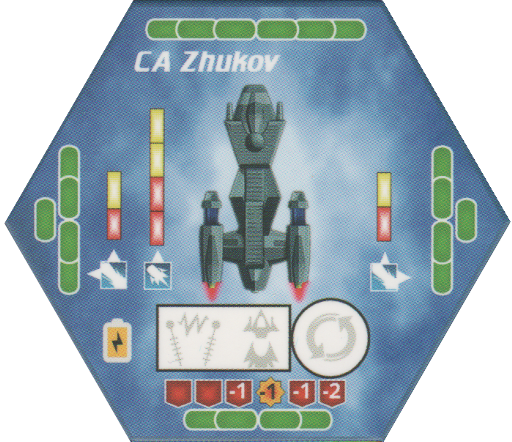
That's quite important, because uniquely among space war games I've
played there is no separate ship control sheet (traditionally with
lots of tiny boxes one ticks off as damage is taken). Instead, each
(large) counter has a dry-erase coating, and one adds and removes
markings to show weapon status, shields, damage. etc.
Also this game is played on a straightforward two-dimensional hex
grid, which removes questions of measurement error (and works against
the "fist of death", stacking all one's ships into the same place so
that they all come into range at the same time, to which many space
war games are prone since the distances over which combat is conducted
are vastly greater than the sizes of the ships).
There is one problem for me, though, which is that it can be a little
tricky to see the full details of a ship's status in a bitmap:
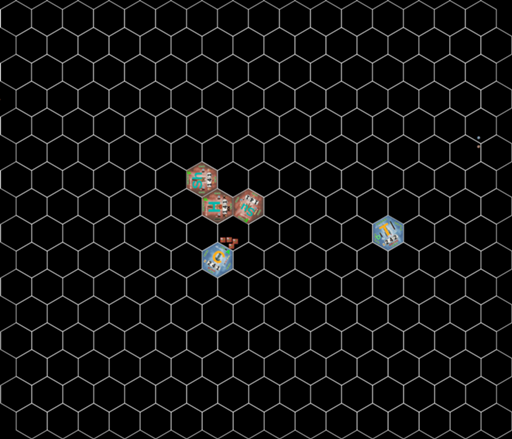
so sometimes I've posted a zoomed-in version to make things clear. I
am, inevitably, working on software to automate plotting and movement
and other such things. The first thing I did was to generate an
impulse chart, as ship speeds vary, and their available power goes up
as their movement speed goes down. For example:
| Ship |
Curve |
A |
B |
C |
D |
E |
F |
| Justice |
1-4-3 |
move |
|
move |
move |
|
AP, move |
| Unity |
1-4-2 |
move |
|
move |
move |
|
AP, move |
| Napoleon |
2-2-1 |
|
|
AP, move |
|
|
AP, move |
| Zhukov |
3-3-2 |
|
AP, move |
|
AP, move |
|
AP, move |
(The first number under "Curve" is the amount of available power i.e.
number of "AP", second is speed i.e. number of one-hex moves, and
third is turning radius.)
But why is Talon especially suited to PBF? Because there's no
simultaneous choice: I take a turn, doing various things which may
involve rolling dice and having effects on you, and then you take a
turn, doing similarly with your own forces. There is never a need for
each side to lock in orders and then reveal at the same time, and thus
no need for a referee. (There is also no hidden information, except
briefly and manageably during setup.) All one needs is a dice roller,
which the forum I'm using already has.
As I write I've played one full game over at
tekeli.li and I'm in the midst of
another, and I'm having a great time with it. Definitely recommended,
even if it doesn't have a ship design system (I don't think I loved
such systems only because they are often easily exploited, but it's
definitely a problem).
Comments on this post are now closed. If you have particular grounds for adding a late comment, comment on a more recent post quoting the URL of this one.