I’ve been doing the Weekly
Challenges. The
latest
involved a converging sequence and a fraction generator. (Note that
this ends today.)
Task 1: Kaprekar Constant
Write a function that takes a 4-digit integer and returns how many
iterations are required to reach Kaprekar's constant (6174).
For more information about Kaprekar's Constant please follow the
wikipedia page.
To summarise, x(n+1) is x(n) transformed thus: take all the digits of
a four-digit number (including leading zeroes), sort ascending and
descending, assemble those into new numbers, and take the difference.
This will end in either 6174 or 0. In the latter case I return -1.
Python:
Convert a list to a number:
def a2n(a):
  t = 0
  for d in a:
    t *= 10
    t += d
  return t

def kaprekarconstant(a):
  ct = 0
  b = a
Start the loop.
while b != 6174:
If we hit the other attractor, return an error.
    if b == 0:
      return -1
Extract the digits.
    digits = []
    for _ in range(4):
      digits.append(b % 10)
      b //= 10
Sort them, and make a reversed copy.
    digits.sort()
    stigid = digits.copy()
    stigid.reverse()
Calculate the new value.
    b = a2n(stigid) - a2n(digits)
    ct += 1
  return ct
Since this is a pretty quick process (nothing that converges takes
more than 7 cycles to do so) I thought I'd also plot a map of the
domain. This is in reading order: top left is 0000, top right is 0099,
and so on, and there are certainly patterns to be had here..
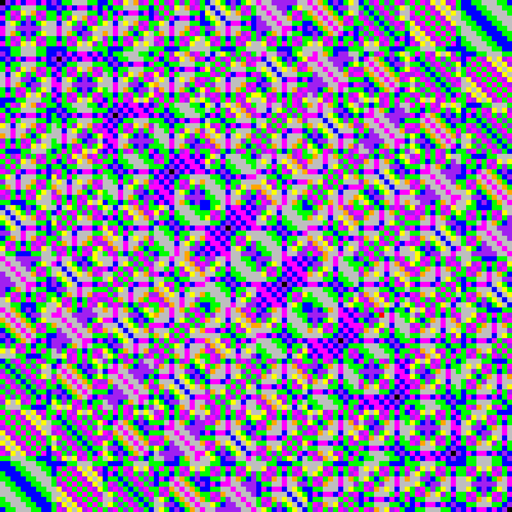
- 0 - red
- 1 - orange
- 2 - yellow
- 3 - green
- 4 - blue
- 5 - purple
- 6 - magenta
- 7 - grey
- no convergence - black
Task 2: Unique Fraction Generator
Given a positive integer N, generate all unique fractions you can
create using integers from 1 to N and follow the rules below:
- Use numbers 1 through N only (no zero)
- Create fractions like numerator/denominator
- List them in ascending order (from smallest to largest)
- If two fractions have the same value (like 1/2 and 2/4),
only show the one with the smallest numerator
So for N=3 I could have nine possibilities (1/1, 2/1, 3/1, 1/2, 2/2,
etc.) which after deduplication and sorting would be:
1/3, 1/2, 2/3, 1/1, 3/2, 2/1, 3/1
My goal in this solution was to avoid floating-point divisions, indeed
any floating point at all.
My approach is to find a common denominator that could stand in all
the possible fractions, and build my list in terms of numerators over
that. In this case it would be 6, and I'd generate 6/6, 12/6, 18/6,
3/6, 6/6, etc.
In Rust I can use a BTreeSet, and read off the entries in sorted
order. Everything else needs a separate sorting step. Perl:
Library gcd function.
sub gcd($m,$n) {
  while ($n!=0) {
    ($m,$n)=($n,$m % $n);
  }
  return $m;
}

sub uniquefractiongenerator($a) {
Find a common denominator for the factions I'm going to generate.
(This could be the GCD of all values from 2 to a but multiplying is
just as easy and unlikely to run into trouble at this scale.)
  my $den = 1;
  foreach my $dn (2 .. $a) {
    $den *= $dn;
  }
Generate a set of numerators, one for each conceivable fraction.
(Which deals with the deduplication, because 1/1 and 2/2 will both
show up here as 6/6.)
  my %f;
  foreach my $d (1 .. $a) {
    my $nd = int($den / $d);
    foreach my $n (1 .. $a) {
      $f{$n * $nd} = 1;
    }
  }
  my @out;
Sort that list.
foreach my $n (sort {$::a <=> $::b} keys %f) {
Express each value in reduced form.
    my $g = gcd($n, $den);
    my $nn = int($n/$g);
    my $nd = int($den/$g);
    push @out, "$nn/$nd";
  }
  \@out;
}
Full code on
github.
Comments on this post are now closed. If you have particular grounds for adding a late comment, comment on a more recent post quoting the URL of this one.