I went to the unfortunately-named British Birds of Prey gathering. It
was… an experience.
We were playing an unpublished prototype of Birds of Prey
second edition, an air combat game. I am told that it's less complex
than the first edition. A custom circular slide rule is a necessity.
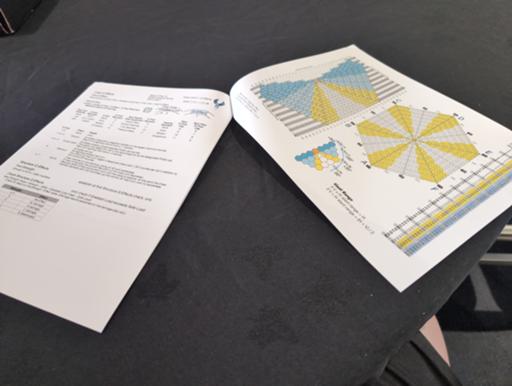
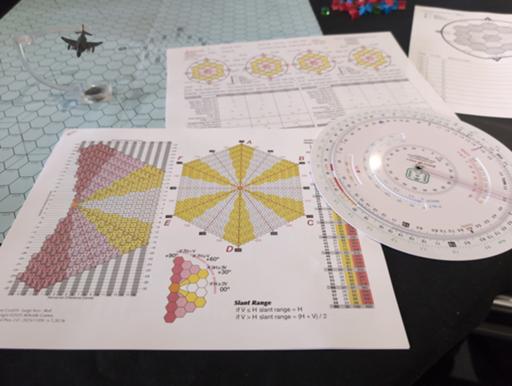
This is, I'm pretty sure, the most complicated game I have ever
played. A hex is about 400 feet, an altitude level 200, a speed point
40 knots, a turn six seconds. (These don't match 100% because Freedom
Units.) One manoeuvre "pull" is ⅓ of a g. Aircraft data cards have
charts for engine thrust developed by speed and altitude, and how
induced drag from manoeuvre changes with mach. Manoeuvre is done by
pulling your velocity vector from place to place (keeping it the same
length), and your actual ending position is changed by half the amount
you changed it this turn (see my Painfully Realistic Vector Movement
post for why). And it's all enthusiastically three-dimensional. Oh,
and if you survive the flying, you should probably try to shoot
someone down before they do it to you.
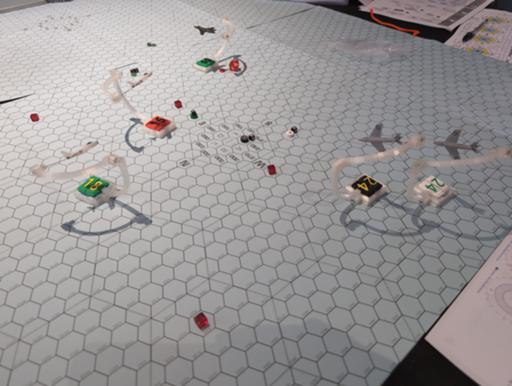
The bulk of the first day was teaching the changes in the system since
last time (substantial enough that I was able to able to pick up the
small amount that hadn't changed too). Then onto an engagement
between Hunters and Furies, which didn't come close to a conclusion
before the end of the day. (Numbers indicate altitude level; matching
coloured markers indicate velocity vectors.)
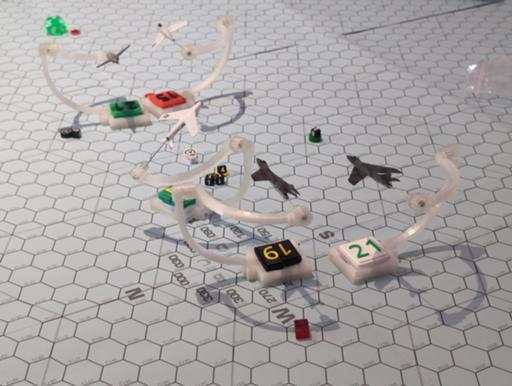
I had to miss the next day, but on Saturday morning I got into a new
scenario: three Mirages vs two RAF Phantoms.
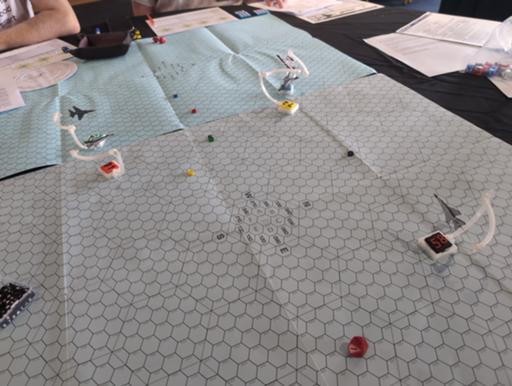
We quickly converged and interleaved. I had the green Mirage, and I
turned hard after the yellow Phantom.
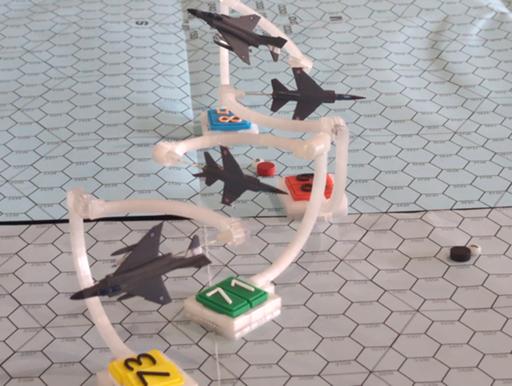
Looks like a good missile shot, though it wasn't; yellow was crossing
my nose fast, and while my R.550 could just barely get close enough to
hit, it was down to only about a 14% chance, and it missed.
(A small irk: the system uses d10s, but 0 is always 0, so even a
"percentile" roll is 00-99. And in fact the missile hit roll requires
you to exceed the calculated number. What I actually had to do was
try to roll 86-99. Come on guys, a range of 1-100 gives you simple
percentage resolution right there, just don't muck about with it.)
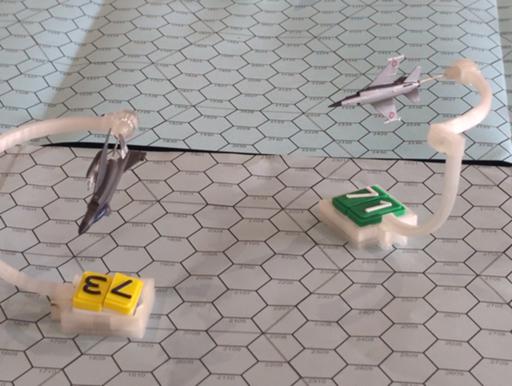
I followed him through the turn hoping for another attack, but this
was an error; I lost a lot of speed (the Mirage's engine really isn't
a match for the Phantom's Speys) and, as you can see, the blue Phantom
was sneaking up behind me.
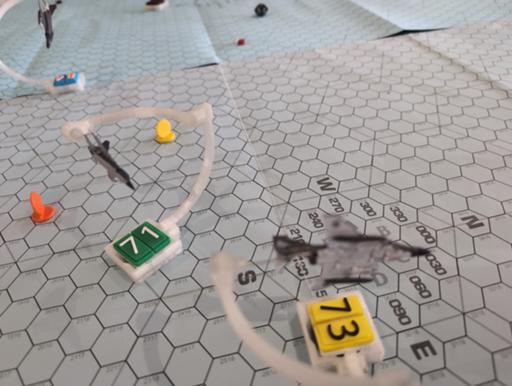
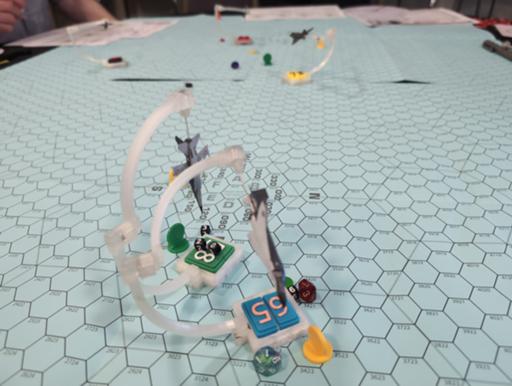
In an attempt to get back some speed and manoeuvreability, I dived for
the deck; blue got his Sidewinder off, but I'd turned hard enough that
it couldn't follow me through. (But off in the background, yellow was
about to kill the red Mirage with a head-on Sparrow shot.) Even
missile fire is a multi-stage process, including consideration of the
delay between pressing the button and the missile beginning
independent flight, the Gs the missile can pull, the number of facing
changes it can do, and so on…
That was one full game to the point where we felt everyone would be
disengaging, five turns, which took about a day and a half to play
(these particular mechanics were new to all but one of the players).
This clearly isn't a game I would play all the time, even if I fully
understood it, which I don't claim to. But it was great fun and I'll
certainly try to make it to this event next year.
Comments on this post are now closed. If you have particular grounds for adding a late comment, comment on a more recent post quoting the URL of this one.