How long a pole can you get through a dungeon corridor?
Obviously the correct answer is to make it sectional, with screw
or cup fittings to hold it together. But assume you can't do that.
The dungeon corridor is assumed to be W wide and H high. We also
assume a rigid pole of length L, of trivial diameter.
The first step is to find the maximum length in two dimensions. The
corner is a W × W square. We'll put one end of the pole at the outside
corner and lay the rest of it along wall A in position ①; then we'll
slide the front end along wall B while the back end slides along wall
A into the corner, though positions ②-⑥, ending up in ⑦. The
constraint is that the pole can't penetrate the inside corner C.
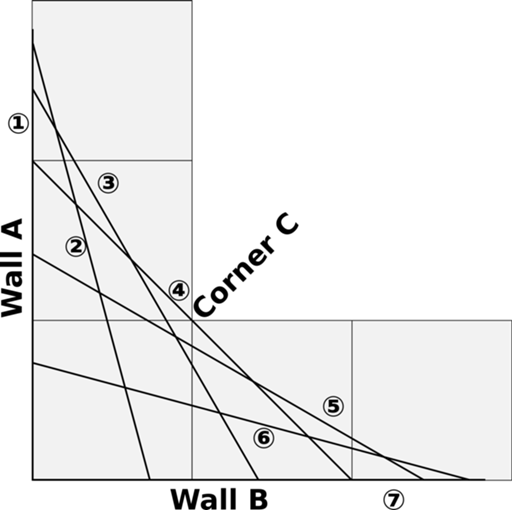
So let's put the outside corner at (0, 0) in our coordinate system.
The pole in its starting position runs from (0, 0) to (0, L), and at
the end from (L, 0) to (0, 0).
I'll call the non-zero coordinates X (the X coordinate of the front
end) and Y (the Y coordinate of the back end).
If the pole will jam at all, it will be jammed when it's at 45 degrees
relative to the corridor (position ④), so that's the position I'll
consider: if it is still free to move there, it'll be free to move
during the rest of the procedure. Since it's L long, its coordinates
must always be constrained by (X² + Y² = L²); at this half-way point,
X = Y, and therefore X = Y = L/√2.
At this moment, the location of the midpoint is half-way between (X,
0) and (0, Y), so we can halve these coordinate values again to find
(L/2√2), which is both the x and y coordinate. This number cannot
exceed W (the x and y coordinate of the corner C) in order for the
pole to fit. So L ≤ 2√2 × W. (In a ten-foot corridor, we can corner
with a pole of 28 feet 3 inches.)
This two-dimensional solution is also the plan view of the
three-dimensional solution, because we can put one end of the pole on
the floor while the other scrapes the ceiling: the maximum pole length
is now √(L² + H²) or √(8 × W² + H²) In the 10-foot corridor with
15-foot ceilings, that's now up to 32 feet.
- Posted by Jon Hancock at
10:16am on
04 July 2026
You could save yourself a lot of complication by simply carrying a 10’ pool noodle instead.
- Posted by Shim at
02:09pm on
04 July 2026
I'm now pondering the usage of 32-foot poles. I can see them being less useful for the traditional pressure plate, because you'll probably want the pole to be light, and exerting much downward pressure 32 feet away will be tricky. A heavier pole will be hard to manoeuvre neatly and might create its own problems. Something bamboo-like seems apt.
On the other hand, probably solid for triggering tripwires and tapping guards on the shoulder while pointing a crossbow at them and making shushing motions. Strap a beetle to it and it might set off magical traps, too.
- Posted by John P at
10:55pm on
04 July 2026
Thank you for clarifying that. Nicely
But of course, in the D&Dverse, it doesn't matter because whatever length the pole is, it'll still fit in the backpack of a 4'6" dwarf along with 2 weeks rations, a bedroll, a spare battleaxe, several litres of oil and a few hundred coins of assorted denominations. Unfortunately.
- Posted by J Michael Cule at
06:15pm on
05 July 2026
Is the pole primarily a weapon (in which case its limits are those the humanoid frame places on its useful swinging) or as a probe. In which case you want a telescoping or modular pole, possibly with specialised tips for probing in water, mud or molten metal.
- Posted by RogerBW at
06:40pm on
05 July 2026
Jon: granted, but it won't do such a great job of poking the floor.
Mike: I first met the 10' pole in Moldvay Basic D&D, in which it was definitely not a weapon. There were no explanations for the equipment that I recall, but I think it got used for sounding out floors ahead of the party, in case they should open under load; occasionally also trying to open a chest from a distance, etc. But yes, as I initially suggested, a sectional pole is clearly a better bet all round; the technology level is fuzzy as always, but friction fit would do to hold it together, and brass screw threads would do much better.
(Reversing the calculation, the 10' pole will go round a 3'6½" corner in two dimensions.)
Shim, some of the members of the League Against Exploitation of Beetles are jolly large and chitinous.
Comments on this post are now closed. If you have particular grounds for adding a late comment, comment on a more recent post quoting the URL of this one.