Disc binding seems to be quite a niche thing these days, but I've
found it very useful for role-playing material.
Not for my own, particularly, which tends to be just a page or
two of notes; but when I'm running adventures written by other people.
I like to print out relevant parts of the PDF and annotate it: I add
details that are elsewhere in the book, any changes I think of while
preparing (such as key numbers if I'm converting to another set of
rules on the fly), and anything that happens while running the game
(most obviously, hit point trackers during fights).
I've been doing that for a while, but a stack of paper can get out of
order, and disc binding is a way of preventing that.
The basic idea is to have a series of T- or mushroom-shaped slots in
the paper, making pairs of flaps. These are then attached to the
discs, each of which has a rim thicker than the body of the disc. The
end result is something like ring binding, but with more load points,
so the stress on each bit of paper is smaller: no need for sticky
reinforcement rings here. Also, you can insert or remove individual
sheets with no need for fiddly opening and closing of rings.
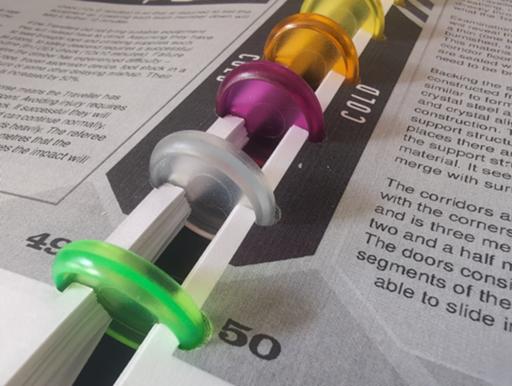
Here's a close-up view from my printout of Mongoose's Bayern
campaign. Cheap mixed rings are enough to get the job done, though at
about half an inch thick this is getting close to the practical limits
of the system. I haven't yet printed all of the campaign, and I may
well remove some of the earlier episodes by the time I get to the end.
(A side benefit of this over the physical books: I could shuffle the
pages into the order in which I was planning to run the various
segments, rather than flipping back and forth between major events and
minor incidents which are in two separate books/PDFs.)
One problem is that if you don't add a card or acetate cover the pages
at the front and back tend to get scruffy and eventually will be torn
away even under quite careful handling.
Another drawback is that one can't really shelve these: not only is
there no spine, the rings necessarily take up more width than the
pages themselves, often a lot more for a small document. For
board-gaming rulebooks, which tend to be rather shorter and for which
I'll probably print a new version rather than insert or remove
individual pages, I'm more inclined to use a slide binder, a plastic
long edge into which all the pages can be placed together.
The original Atoma patent expired in the 1990s, and there are now many
imitations of varying quality: Rollabind and Circa are the usual
names. When I last checked, Amazon UK also had "Lanzhi", "Xiarui",
etc., as well as some very pretty discs. You can buy paper too, but
it's more interesting to punch one's own. (After printing; the flaps
won't survive a trip through most mechanisms.) Punches are of very
variable quality, and some are highly expensive. 11 holes for
lone-edge A4 is best; the one usually available (under various names,
often "Craftelier")) is pretty solid, but only copes with three sheets
at a time, and only makes nine holes . The best one is the Staples Arc
punch (the full 11 punches, and seven sheets at once), but this is not
reliably available for a reasonable price in the UK. (I got mine by
watching eBay for a few weeks.)
If you're designing paper layouts for punching, the discs are at 25mm
intervals, and the stem runs 10mm from the edge before the flare
(which is of variable size depending on the punch, perhaps 5-8mm
wide).